

What is Influencer Marketing?
Influencer marketing is a marketing method in which influencers with a strong presence on social media introduce a company's products or services.

Because information reaches consumers in a natural way, it is more trustworthy than traditional advertising and effective at driving purchasing behavior and increasing brand awareness. Another key advantage is the ability to directly approach your target audience.
In particular, fans and followers of the targeted influencer are already in a mindset that makes them more likely to purchase the products or services introduced, making this a highly effective approach.
Main Types of Influencers
The main types of influencers are as follows.
- Mega Influencers
- Middle Influencers
- Micro Influencers
- Nano Influencers
Here, we explain each type.

Mega Influencers
Mega influencers are extremely large-scale influencers with over 1 million followers.
They include celebrities who appear on TV and in magazines, popular YouTubers, and Instagrammers.
With the power to reach hundreds of thousands to millions in a single post, they are ideal for brand awareness campaigns and large-scale promotions.
On the other hand, the cost per post is often very high, and because follower relationships are more distant, direct calls to action for purchasing or service use may not always be effective.
Therefore, they are best utilized for nationwide product launch campaigns and announcements of major events.
Middle Influencers
Middle influencers are those with tens of thousands to hundreds of thousands of followers who have strong influence within a particular genre or community.
They often specialize in specific fields such as fashion, beauty, and cooking, making them well-suited for targeted marketing.
Furthermore, they are relatively close to their followers and tend to receive responses through comments and DMs, making it easier to convert followers into buyers or service users.
Since the cost of hiring them is lower than mega influencers and effectiveness is easier to measure, managing cost-effectiveness is also a key advantage.
Micro Influencers
Micro influencers are those with thousands to tens of thousands of followers, whose strength lies in their close relationships with their audience.
A key characteristic is the high impact of word-of-mouth and reviews, enabling highly credible information dissemination.
They are particularly well-suited for regionally limited products, small-scale campaigns, and niche products in specific genres, and can deliver high engagement at low cost.
They are also frequently used for PR of local cafes, regional events, and limited editions of specific brands.
Nano Influencers
Nano influencers are very small-scale influencers with hundreds to thousands of followers.
They are characterized by very strong trust relationships with their followers and high response rates to individual posts.
Therefore, they are well-suited for test marketing of new services or prototypes, and PR of niche market products, and high effectiveness can be expected even on a low budget.
Nano influencer posts are also relatable and approachable, making it easy to encourage actions such as comments and shares.
How Influencer Marketing Works
Influencer marketing involves having "influencers" with many social media followers introduce a company's products or services.

Companies ask influencers to post advertisements for their products and services, and the influencers disseminate information through photos, videos, and review articles.
Influencer advertising posts are characterized by being able to appeal to products and services more naturally compared to conventional advertising, which has a stronger "ad" feel, making it easier to capture follower interest.
Furthermore, when post content is shared on social media, organic viral effects can also be expected.
This is the mechanism that makes influencer marketing work.
4 Benefits of Implementing Influencer Marketing
The main benefits of implementing influencer marketing are the following four.
- Easy to reach your target audience
- Less advertising feel, easier to be accepted
- Easier to build trust and empathy
- Easily spread on social media
Here, we explain each benefit.

Easy to Reach Your Target Audience
One of the benefits of influencer marketing is how easy it is to reach your target audience.
Because influencers have many followers who specialize in particular genres or interests, they can directly approach the target demographic that advertisers are aiming for.
For example, a cosmetics influencer can deliver information to women interested in beauty, while a sports influencer can reach an active lifestyle audience.
Since influencers can be selected based on their followers' age, region, and interests, precise targeting is possible while using the advertising budget efficiently.
Less Advertising Feel, Easier to Be Accepted
Another benefit is that because it has less of an advertising feel, it is more readily accepted.
Unlike conventional advertising, products can be introduced naturally within everyday posts and stories, making followers less likely to perceive it as "promotion" and more likely to accept the information without resistance.
In particular, especially among younger generations, there is a growing tendency to view social media as a more reliable source of information than corporate advertising.
Therefore, products and services introduced by influencers can convey their appeal in a straightforward way, making it easier to inspire a desire to purchase.
Easier to Build Trust and Empathy
Implementing influencer marketing makes it easier to build trust and empathy toward your products and services.
Since followers already empathize with the influencer's lifestyle and opinions on a regular basis, they naturally tend to develop trust in the introduced products and services as well.
Furthermore, by incorporating actual personal experiences and reviews into posts, it is possible to give a more realistic impression than direct corporate advertising.
Building empathy and trust with users is a crucial element that makes it easier to lead them toward purchasing behavior and service use, so actively keep this in mind.
Easily Spread on Social Media
When posts introducing a company's products or services are retweeted, shared, or liked, information naturally reaches users beyond just the influencer's followers.
If the product or campaign has buzz-worthy appeal, a viral post can rapidly expand brand awareness all at once.
Furthermore, because influencer posts function as word-of-mouth, long-term brand recognition and improved credibility can be expected while keeping advertising costs low.
Unlike conventional advertising, the ability to expect secondary effects is also a major benefit of influencer marketing.
3 Precautions When Implementing Influencer Marketing
The main precautions when implementing influencer marketing are the following three.
- Risk of backlash or undisclosed advertising (stealth marketing)
- Difficulty measuring cost-effectiveness
- Choosing the wrong influencer can be counterproductive
Here, we explain each precaution.

Risk of Backlash or Stealth Marketing
When implementing influencer marketing, it is important to understand the risks of backlash and stealth marketing.
In particular, if an influencer's words or post content unexpectedly cause a backlash, there is a real possibility that the brand image could be significantly damaged.
Also, introducing a product or service without disclosing that it is a paid promotion may cause followers and consumers to view it as stealth marketing and lose trust in the brand, so caution is advised.
Difficulty Measuring Cost-Effectiveness
Difficulty in measuring cost-effectiveness is also a key precaution when implementing influencer marketing.
While access numbers and likes are easy to check, accurately measuring whether it has actually led to increased sales or service use can be difficult.
Especially when implemented for branding purposes, short-term results can be hard to see, making it important to be aware of the challenges in judging cost-effectiveness.
Choosing the Wrong Influencer Can Be Counterproductive
Selecting an influencer based solely on follower count may result in low affinity with the target demographic and reduced advertising effectiveness.
Furthermore, choosing an influencer with a history of controversy or whose content lacks credibility carries a high risk of negatively impacting your brand image.
Therefore, it is important to verify affinity with your target demographic and genre, and to check the influencer's past post content and credibility before making your selection.
How to Implement Influencer Marketing [4 Steps]
The main steps for implementing influencer marketing are as follows.
- Clarify your objectives
- Set your target and choose your influencer
- Design your campaign and post content
- Measure effectiveness and make improvements
Here, we explain each step.

Clarify Your Objectives
First, clearly define the objectives of your influencer marketing campaign.
For example, common objectives include "increasing brand awareness," "promoting product sales," "improving company image," and "branding."
Make sure to firmly establish your objectives before proceeding with implementation. Note that vague objectives will also make measuring effectiveness difficult.
Set Your Target and Choose Your Influencer
Next, define specifically what kind of users you want to approach by setting your target demographics.
Mainly, clarify attributes such as "age," "gender," "region," and "hobbies and preferences," and then determine the direction of your influencer selection and post content.
By narrowing down your target, you can improve advertising effectiveness and reduce unnecessary advertising costs.
Design Your Campaign and Post Content
Work together with the influencer to design how they will introduce the product or service, including the format of the post, timing, and use of hashtags.
By clearly disclosing that it is paid content and devising how to approach followers, it is possible to achieve both credibility and strong viral reach.
Measure Effectiveness and Make Improvements
After posting, measure metrics such as reach, engagement, click-through rates, and sales, and analyze effectiveness against your KPIs.
By identifying areas for improvement based on effectiveness measurement and applying them to future campaigns, even higher effectiveness can be expected.
3 Key Points When Choosing an Influencer
The main key points when choosing an influencer are the following three.
- Check engagement rate rather than follower count
- Check whether they have reliability and consistency
- Check whether there is affinity with your brand, products, and services
Here, we explain each key point.

Check Engagement Rate Rather Than Follower Count
The number of followers alone makes it difficult to accurately judge actual advertising effectiveness.
Primarily, it is important to prioritize the engagement rate of posts, such as "likes," "comments," and "share rate."
A high engagement rate indicates that followers are strongly interested in the post content, suggesting a higher likelihood of leading to actual purchases or service use.
Therefore, check engagement rate rather than follower count when selecting an influencer.
Check Whether They Have Reliability and Consistency
It is also important to review the influencer's own posts and activity history to confirm there have been no controversies or stealth marketing issues in the past.
In particular, whether they can build long-term relationships with their followers is also critical.
Even if they attract short-term attention, if credibility is low, there is a risk of damaging the brand image.
Therefore, it is important to choose influencers with high credibility and consistent post content.
Check Whether There Is Affinity with Your Brand, Products, and Services
It is also important to confirm whether the influencer is a good match for your company's brand, products, and services.
The higher the affinity, the more naturally users will become interested, increasing the likelihood of purchase or use.
In particular, it is important to consider the target audience's "age," "gender," and "interests," and to choose an influencer that aligns with your brand image.
It is also a key point to check whether they have a track record of promotions in the same genre in the past.
Tomira — Helpful for Influencer Marketing
Tomira's "Influencer Casting" service provides comprehensive support from influencer selection to post management and effectiveness measurement.
Primarily, it analyzes follower attributes and engagement rates, enabling efficient selection of influencers best suited to your brand.
Furthermore, post management and real-time response monitoring are also available, so even beginners in social media operations can achieve results.
In addition, since multiple social media platforms can be managed cross-functionally, it is also recommended for those who want to efficiently approach a wide range of targets.
Tomira Influencer Casting
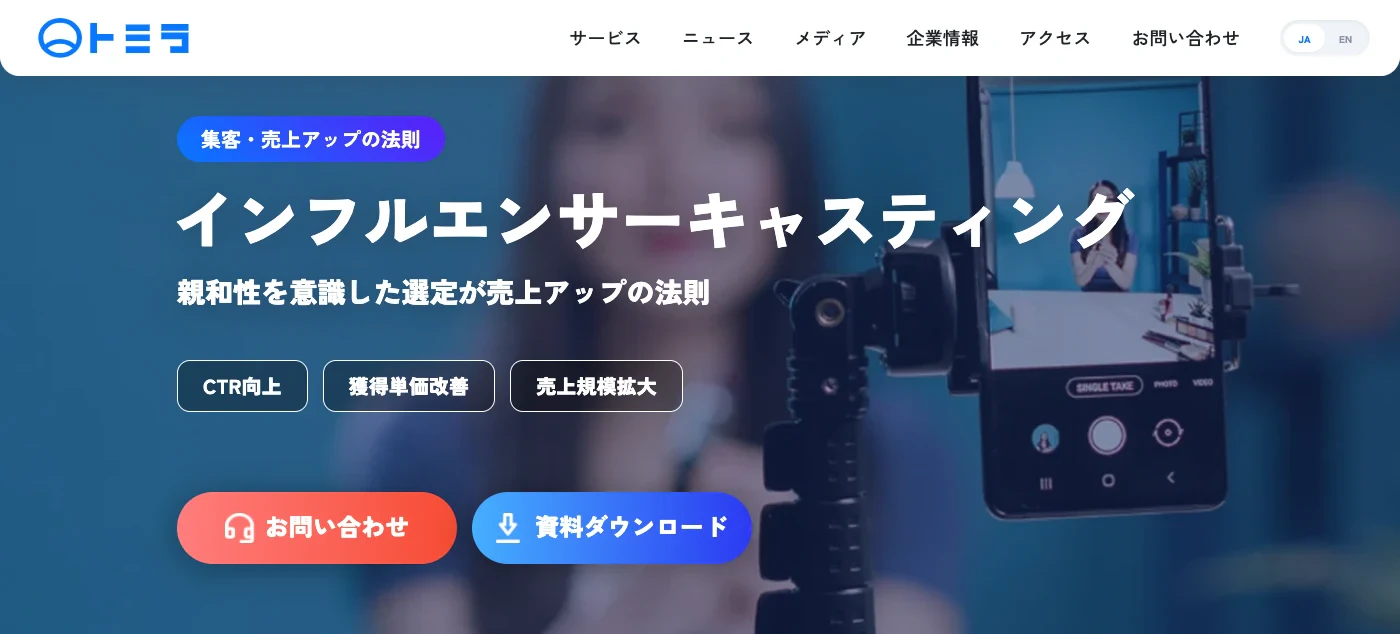
Tomira provides services specialized in influencer casting operations. Our dedicated team handles everything from casting to creative production and operation consistently, providing optimal support for our clients. We also utilize unique know-how obtained from extensive advertising and SNS operation experience.
Casting by Influencer Marketing Professionals
Because influencer marketing professionals perform proposals utilizing the latest raw data obtained from extensive casting experience, such as influencer track records, affinity with products, and global trends, we can generate results with a very high degree of accuracy.
From Casting to Creative Production and Operation
At Tomira, you can request not only the casting of talents and influencers but also creative production and account management as a whole. Professionals specializing in each department form a team to provide high-precision support.
Optimized Listing Based on Multiple Indicators
We visualize the influence of influencers active on Instagram and X (Twitter) through various indicators such as follower count, post engagement, demographic attributes, past results, and performance forecasts, and provide the optimal list for your company.
| Item | Content |
|---|---|
Service Name | Tomira Influencer Casting |
Company Name | Tomira Inc. |
Address | BIZ SMART 235, 2-12-8 Kita-Aoyama, Minato-ku, Tokyo |
Business Content | ・Web/Digital Marketing Support |
Official Site | https://tomira.co.jp/marketing/casting/ |
Summary
Influencer marketing is a method of spreading products and services through people with influence on social media.
Because it has a low advertising feel and can approach targets naturally, it is effective for expanding awareness, promoting sales, and branding.
However, be sure to keep in mind the precautions, such as the risk of backlash and stealth marketing, as well as the difficulty in measuring cost-effectiveness.
Companies planning to implement influencer marketing in the future should definitely use this as a reference.